DI Labs open house · Tour story
The Life of
a Project.
Tour overview
Welcome
Opening & DI Labs Talking Points
Additive Manufacturing Talking Points
- Industrial additive manufacturing is grown-up 3D printing
- It builds parts layer by layer from a digital file, rather than cutting material away (machining) or injecting it into a mold (injection molding)
- Historically associated with prototyping — a fast way to see and test designs
- Now used for production of parts with complex geometries that traditional methods can't make, or programs that require extreme speed and agility with no time for tooling
- Many different additive manufacturing technologies and materials
DI Labs Talking Points
- Solutionology is our culture – we are all solutionologists – problem solvers
- Not focused on prototyping like most additive manufacturing providers
- Experts at production, which is defined by quality and control (not volume)
- Whether it’s 10 or 100,000 parts, every single one is exactly the same
- Our best customers need parts that are difficult to make or have extreme, specific quality standards that allow little margin for error, like medical device, defense and precision industrial
- Parts going through our system are tied to a digital record that tracks every touchpoint and data related to that part’s journey
Internet connection required. If playback is unavailable, use the talking points to continue the tour.
Guide note
We should identify a clip from this video
Internet connection required. If playback is unavailable, use the talking points to continue the tour.
Guide note
We should identify a clip from this video
Stop 1 · Front office · Solutions Support
Request, Engineering Review & Locked Record
Every job starts as a client request — typically an RFQ for a part or program.
Talking points
- Solutions Support team reviews the request for manufacturability and scheduling before providing a price
- The part's "DNA" — specs, material, quality expectations, and the design file are documented in a digital record
- Quote is sent to the client, they send a PO, and it converts to a sales order
Stop 2 · Front office · Operations
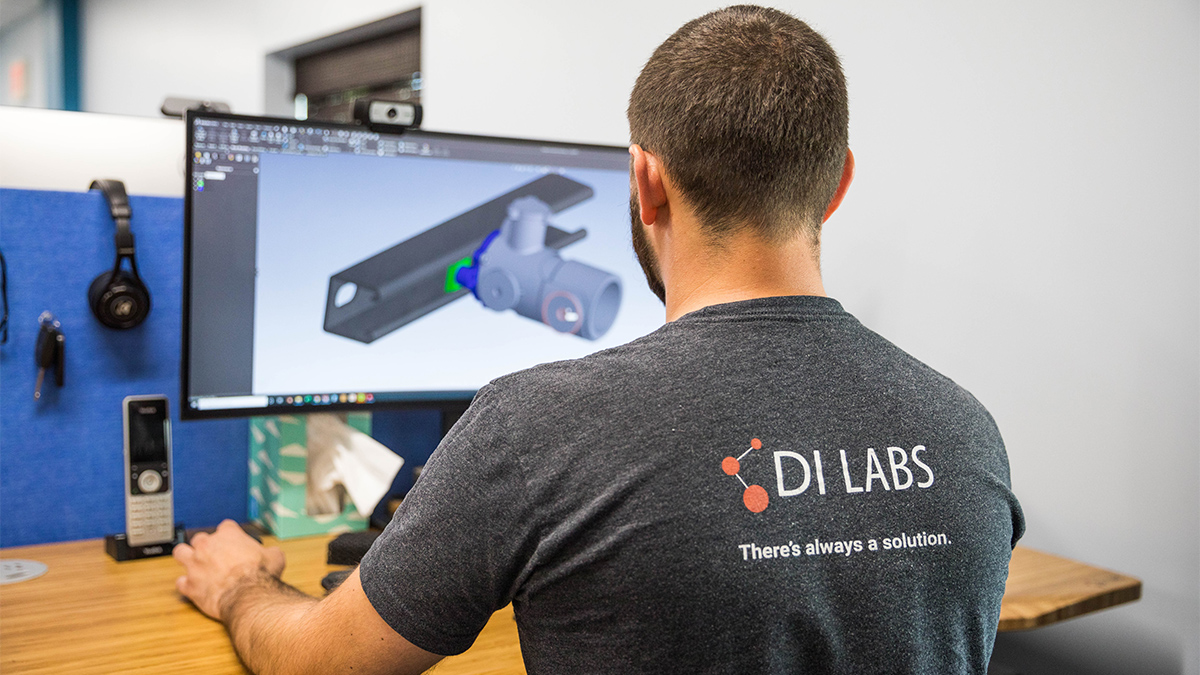
Production Scheduling & Build Design
Sales orders are scheduled and build designs are prepared.
Talking points
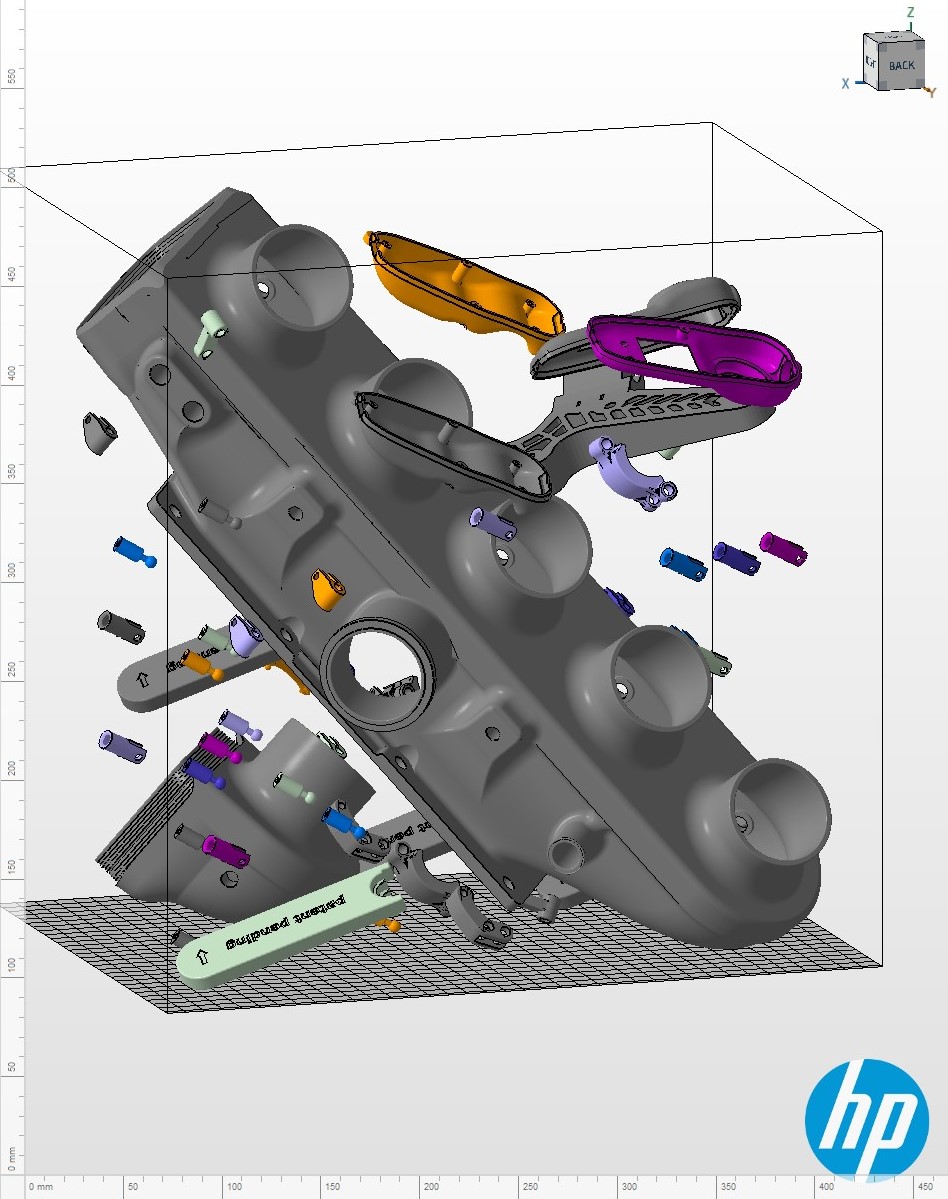
- Running dozens of part types and programs at any given time. Must find ways to combine builds for maximum efficiency
- Build-design team sets orientation and process settings to match the client's quality expectations and timeline.
- Builds are designed with density and distribution in mind — DI Labs prioritizes quality over quantity when deciding how tightly a build is packed.
- The build design is locked permanently into the record — the same instructions apply every time that part is produced again.
Stop 3 · Production · Processing stations
Processing Centers
Builds begin and come back here.
Raw material becomes a loaded build cart then returns here after printing to be unpacked.
Talking points
- Each processing center and build unit runs one dedicated material — no cross-contamination.
- Build carts are loaded with material here for printing.
- Proactive machine maintenance starts here — consumable components are tracked and addressed before they cause a problem.
- Build units come back through processing stations after printing for unpacking.
- Material lot is added to the part’s digital record.
Stop 4 · Production
MJF Print Room
Main printing area.
A climate-controlled room — both the powder and the print process are thermally sensitive. Printers line the walls and build carts sit in the center ready for printing or still cooling.
Talking points
- How MJF works: the printer spreads a thin layer of plastic powder, then uses inkjet nozzles to apply a chemical agent, which infrared heat lamps melt together to fuse that layer.
- Build carts move through the room as builds progress from loaded, to printing, to cooling.
- Print start, finish, and cooling time are all added to the digital record automatically, and machine performance and maintenance are tracked alongside it.
Internet connection required. If playback is unavailable, use the talking points to continue the tour.
Stop 5 · Production
Decaking, Depowdering & Routing
Unpacking, depowdering and first QC check before routing to post processing.
After cooling, build units go back into the processing center to be unpacked, depowdered, and routed.
Talking points
- Unpacked parts are vacuumed then move through the barrel blaster and other methods to remove remaining powder.
- Parts are carefully checked for defects then separated into individual bins for routing to their post-processing destination.
- Defects and part counts are logged into the digital record.
Stop 6 · Production
Surface Smoothing
Creating smooth, sealed and sanitizable surfaces.
Chemical vapor smoothing, using two technologies: DyeMansion and AMT PostPro.
Talking points
- The process creates injection-mold-quality surfaces that are sealed and sanitizable.
- How it works: parts sit in a controlled vacuum atmosphere with circulating vapor, which melts the outermost microscopic layer of the polymer — causing it to flow into valleys and smooth out rough layer lines.
- Details of the smoothing process are logged into the part's record.
Internet connection required. If playback is unavailable, use the talking points to continue the tour.
Stop 7 · Production
Other Printing Technologies & Work Cells
Utilizing the right technology and material for the job
We offer a variety of other printing technologies suited to different needs.
Talking points
- Full Color MJF and Ultra White MJF — additional MJF material/finish variants alongside standard production runs.
- Carbon — uses light and oxygen to rapidly grow solid parts from a pool of liquid resin.
- Formlabs — specialized stereolithography (SLA): laser light turns liquid plastic into solid, highly detailed objects layer by layer.
- Ceramic coating – available as a finishing option.
- Stratasys, AON, and Markforged — fused filament polymer printers.
Stop 8 · Production
Special Projects
Doing specialized work like adding features for assembly
Hands-on or robot-assisted work for special features
Talking points
- Metal inserts can be heat-staked or glued in, depending on the application.
- Threading for screws can be added directly.
- The part’s digital record supplies instructions.
Stop 9 · Quality
Digital Scanning for Dimensional Verification
Used for the most extreme quality requirements.
Talking points
- CMM (coordinate measuring machine): scans a printed part and compares it to the design file
- Details are logged into the part's digital record.
Internet connection required. If playback is unavailable, use the talking points to continue the tour.
Stop 10 · Production
Dyeing Station
The option to print in color.
Most common is gray MJF parts dyed black or white MJF parts dyed to color.
Stop 11 · Quality
Final QC Check
Goal is 100% good parts shipped
Every batch and part is inspected, counted, approved, and photographed before shipping.
Talking points
- Measuring tools like calipers and gauge pins are used to check parts against specified quality requirements, which can be different for each part or program.
- Internal cameras throughout the facility can track any part's journey if ever needed.
- Less than 30% of all defects are caught here — most are caught upstream, at the routing station.
- Inspection results and photos are added to the digital record.
Stop 12 · Order fulfillment
Picking & Packing
Organizing and preparing parts for shipping.
After inspection, every part is placed into a picking bin for packaging.
Talking points
- A dedicated picker carefully packages items into labeled bags with part information (name, part number, etc.).
- Once picked, items go into a dedicated sales-order (SO) bin, ready for shipping.
- Picking and packing is tracked against the part's digital record, keeping the chain of custody intact right up to shipment.
Stop 13 · Order fulfillment
Labeling & Shipping
The final step of labeling and staging for shipment.
Staying organized is key!
Talking points
- Correct shipping labels are automatically generated from the part’s digital record that includes logistical information and packaging requirements.